Webster’s New World Dictionary defines the term effective as “producing a definite or desired result; efficient.” What is effective music? All music is effective to some degree or purpose in the classroom. Music can speed us up or slow us down. Music can make us giggle or bring tears to our eyes. Music can teach us concepts and tell a story as well as the best storyteller.
Music is orderly and research shows that students who possess the ability to learn the language of music have a much easier time learning other concepts as well. Effective music is music which produces a desired learning outcome. Just as a teacher selects good literature – music should be selected at home and in the classroom to achieve an intended effect.
Different genres of music promote different responses in children. What is the desired outcome? Is it more focused behavior? Do you want to calm down an overly enthusiastic class or child? Will children move to the music? Is the music intended to develop language and/or critical thinking skills? Reinforce comprehension? Most important, will the students sing along or merely listen to the music?
Whatever the desired outcome, there are five key elements to consider when selecting the most effective music for young children. The music must have:
1. an easily recognized melody
2. a visual quality (what images does the music bring to mind?)
3. a ‘hook’ or repetitive lines for easy recall
4. an identifiable rhythm and meter, and
5. if the music is for sing-along purposes, written in keys appropriate for a child’s vocal range
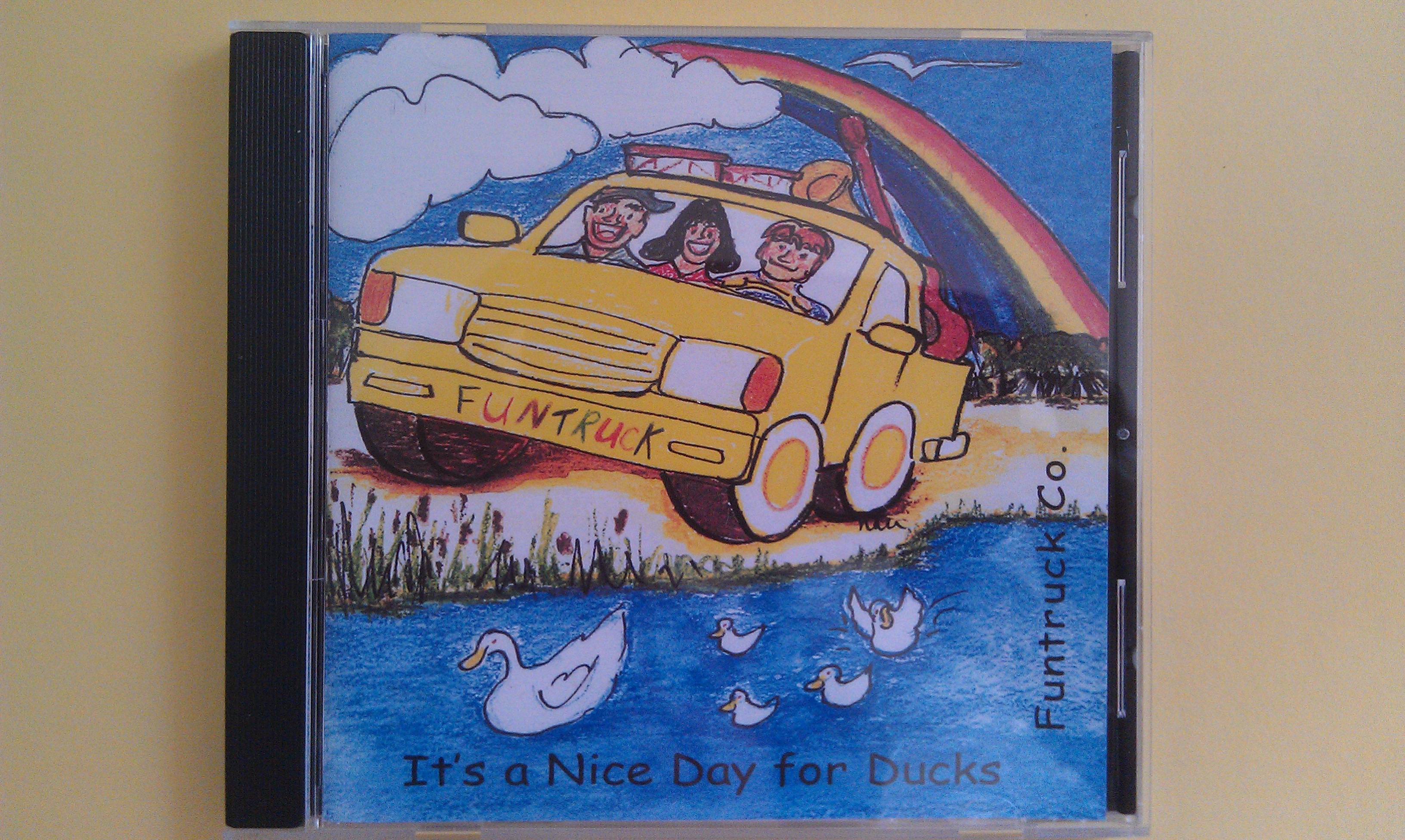
Listen to the following segment from a song on the CD “It’s a Nice Day For Ducks.” Are you singing it easily after listening?
A song that is easy to sing along with will more likely be remembered. One that isn’t will more likely be tuned out. You’re probably asking, “How am I supposed to tell if a song is in the right key?” An identifiable clue is – is the child singing on pitch or merely speaking the words?
Music has an inexplicable effect on young children, not only during music for enjoyment times at home, but during instructional and transitional times in the classroom as well.
Music is an effective part of the early learning experience – not just a filler to use up extra time. All areas of learning are enhanced through thoughtfully selected music.
For another example of an easily recognized song listen to “Rainbow” located in the middle column…
From its inception in 1868 as Decoration Day to its official declaration as Memorial Day by Congress under the direction of President Lyndon B. Johnson in 1966, Memorial Day has been more than just another holiday to celebrate with cookouts and family gatherings.
Memorial Day is the day to honor the fallen men and women from every race, creed, and culture who have made the ultimate sacrifice – life, to ensure the American Republic so hard fought for and won remain, allowing every American the opportunity to live in a democracy governed by the people and for the people through elected representation.
To understand and truly appreciate the American culture and form of government, America’s future leaders – our children – need ample opportunity to learn about America’s history. Memorial Day 2021 is the perfect day to start…
Five of the most memorable patriotic songs for kids…
Justin Paul and his team won the Academy Award for the best song, “City of Stars,” in the movie “La-La Land.” Justin gave a wonderful shout out to public education, where he said that “arts and culture were valued” and resourced, and he thanked his teachers. He and his group are also responsible for the […]
Throughout history, music has been used as an instrument of sociality for cultures the world over. Its power has been touted as the great elixir of both physiological as well as emotional ills. Researchers have studied its effect on emotional/social development, physical development, and intelligence.
The role of music in the education of the young child is at the forefront of all other early learning since the child’s musical intelligence overlaps and intersects with all other intelligence defined by Gardner (Thurman, Chase, and Langness, 1987). Music is a precursor to the development of the other intelligence: linguistic, musical, bodily kinesthetic, logical-mathematical, spatial, and personal (Boyd, 1989).
Visualize the following scenario. Ten kindergarten children are singing the song Five Little Bunnies. Their musical intelligence is used as they sway left to right in rhythm with the music. Their logical-mathematical intelligence is piqued in the counting of bunnies. Their linguistic skills are developed when they create their own personal interpretation of the song. Their spatial and personal development is stimulated as they move around like a bunny.
Children love to sing. Singing generates emotional dimension and is extremely important in social/cultural development since it and culminating activities are invaluable to establishing group identity. Ritualized singing at the beginning and end of play periods develops a meaningful bridge between the child’s home life and school life. (Boyd, 1989).
Meaningful, well-constructed songs are easily memorized and will come to mind at any given moment providing the child singing it a comforting reminder of earlier activities or learning experiences.
According to researcher Howard Gardner, there are nine ways of being smart. Children are “natural” learners and learn best in ways that are “natural” to their innate learning style(s).
Howard Gardner’s Multiple Intelligences…
Body Smart
Music Smart
Picture Smart
Number Smart
Word Smart
People Smart
Self Smart
Nature Smart
Existential Smart
It’s interesting to note that music lends itself to all ways of being smart when it comes to acquiring pre-reading skills in early childhood. Here are just a few examples of integrating “music smart” with “partner smarts” to make learning basic pre-reading skills interesting and fun.
Body and Music Smart
Move body to form letter shapes to music.
Jump rope to the alphabet song.
Music Smart
Sing vowel sounds.
Use lyrics to simple songs to find and circle letters.
Picture and Music Smart
Illustrate and label pictures to a song.
Create an adaptation songbook.
Number and Music Smart
Count the number of bunnies in a song.
Order events in a songbook.
Word and Music Smart
Sing the “Word Family Song”.
Find and circle words in a song or lyrical poem.
People and Music Smart
Share and teach favorite songs with someone.
Sing with a buddy.
Self and Music Smart
Sing aloud to a stuffed animal friend.
Listen to a rhyming songbook on CD.
Nature and Music Smart
Text to real world connections. Name the living things you see outside? What songs do they remind you of?
Sing and dance to “Here We Go Round the Mulberry Bush” while circling a tree or bush.
Existential and Music Smart
Find letter blends in the song “Giving”.
SIng a friendship song. Brainstorm the ways to be a good friend.
Multiple styles can and should overlap in any learning activity but it should be noted that including music turns a not so interesting lesson into one that piques a child’s curiosity and attention span!
Click on the link below for an enlightening article on information we should inherently know. Parents, teachers, and community – join in and speak up for children. The arts – in particular music, play a critical role in high student achievement. The problem that presents itself in education is many non-musical people set the curriculum guidelines that all educators must follow. I once had a kindergarten teacher tell me she did not see the value of music to kindergarten students. My heart sank! How much time are your children or students allowed to take part in the arts at school? Head’s up! Thirty minutes a week is not enough.
Music is a positive supplement to any curriculum. Using music to enhance curriculum – especially in early childhood, stimulates the brain’sneural coding which aids learning in later years. Here are just a few of the ways music can enhance your classroom curriculum:
Singing encourages language development. Music is generally processed on the right side of the brain and language on the left. Singing involves both words and music and results in stimulating hemispheric interactions.
Music is not just for listening, but can be expounded upon the same way any good literature choice can. In a study of preschoolers’ responses to auditory and vibroacoustic stimuli, J.M. Standley found that comprehension of literature was greatest for those students listening to the music-only version of the story.
Children can listen to music with eyes closed and create a picture in their minds. Writing about their picture enhances phonemic awareness and focus skills.
Singing favorite songs develops pitch and intonation skills required for vocal cord development, thereby improving oral language skills.
Campbell, D. (1997). The Mozart effect: Tapping the power of music to heal the body, strengthen the mind, and unlock the creative spirit. New York, New York: Avon Books.
D’Agrosa, E. (2008). Making music, reaching readers: Making powerful connections possible for young students. General Music Today (Online), 21(2), 6-10.
I remember sitting in my undergraduate music class that first day, listening to the concerns expressed from fellow students about the preconceived difficulty of the music course they were about to take. Many thought it was out of their realm of comprehension – ergo, they feared the worst – that they were about to embark on the most strenuous of all courses they had to take. As many in class experienced, music isn’t difficult. More important, one doesn’t have to be an accomplished musician to reap the immense benefits music has to offer.
This blog is for primary educators (musical and non-musical), parents, and children. It offers ways to develop musicality in the classroom and at home. Explore the songs, rhymes, poems, and finger plays that appear over time for ways to encourage learning while keeping children entertained in the process.
“We cannot know the consequences of suppressing a child's spontaneity when he is just beginning to be active. We may even suffocate life itself. That humanity which is revealed in all its intellectual splendor during the sweet and tender age of childhood should be respected with a kind of religious veneration. It is like the sun which appears at dawn or a flower just beginning to bloom. Education cannot be effective unless it helps a child to open up himself to life.”
Maria Montessori
Calendar
March 2026
S
M
T
W
T
F
S
1
2
3
4
5
6
7
8
9
10
11
12
13
14
15
16
17
18
19
20
21
22
23
24
25
26
27
28
29
30
31
Archives
Need ideas for classroom use?
Below you will find classroom materials and ideas for use with the songs from "It's a Nice Day for Ducks." Have you found success with your creative ideas to add? Be sure to contact me for publication! We all learn best when we share our ideas and successes. Thanks in advance for sharing!
Classroom transition times can sometimes be the most trying times of the school day. Does it ever seem to take forever for your students to finish one task and move quickly and quietly to another? For a simple and effective way to encourage on task behaviors, try playing I Will Listen as a feel good reminder and a motivating cue!
"It's raining, it's pouring..." Is rain dampening your outdoor learning activities? Sing along with It's A Nice Day for Ducks and follow-up with appropriate extension activities to see just how much fun a rainy day can really be!
Rainbow
"The colorful rainbow, a sign in the sky, says rain now has passed, the sun will now shine!" Teach all the colors of the rainbow with this memorable song that makes learning the colors of the rainbow as easy as counting 1-2-3!
Opposites
You say your class can't figure out which end is up? Provide a simple top/bottom fold opposites flip book made from commercial clip art for visual cues. As you sing Opposites with the children a few times that won't be a problem anymore!
Giving
Teach your children a few simple ways to help make the world a better place. Sing Giving to reinforce kindness, friendship, and sharing!
Five Little Bunnies
Their mother always told them, "Never go into someone else's garden - it's not the right thing to do." Find out what happens to Five Little Bunnies when they don't listen to their mother and go into a garden that's not their own. There are lessons to be learned and lots of creative ways to learn them in this song!
Numbers
How far? How old? How many? What time? Did you ever stop to think about a world with no numbers? Set the purpose for learning math... Listen to Numbers!
Dinosaur Rock
Can you do the D-D-Dinosaur Rock? There’s nothing to it! Just put your right foot out and hold your left hand high and you can do the D-D-Dinosaur Rock! Let T-Rex, Oviraptor, Brontosaurus and friends teach you the dance craze that’s sweeping the nation! Let’s do the D-D-Dinosaur Rock!
Sing a Happy Song
What do you do when a child's tears start flowing and you have a class full of children to attend to? Play Sing A Happy Song and watch the tears quickly dry as friends instinctively reach out to help another feel better!
Yes I Did
Here’s a feel good way to lead your students to follow directions! Yes I Did presents positive words woven into a reggae beat that definitely results in positive actions!
Two Kinds
"We all start out as little boys and girls." In need of a good way to promote multiculturalism in your classroom? Let Two Kinds get the message across for you. Understanding the world and people around us has never been easier!
Big Red Circle
What happens to a mischievous Big Red Circle that rolls away to have some fun? Prompt an interesting discussion as to why it’s best to stay where one belongs while teaching colors and shapes in this fun song!
Reach for the Stars
Many of us can remember a song that led us to believe wishing on stars would make all our dreams come true. These days it's not that easy! Sometimes you have to reach! Invigorate and motivate your students by singing and moving to Reach For The Stars!
What educators are saying
“When we first listened to IT'S A NICE DAY FOR DUCKS, our faces broke into smiles, our feet tapped, we commented on the repeated phrases (both music and lyric), and said we could picture children sitting straight and tall as they sang along with 'I Will Listen.' This is truly a CD for classroom students and teachers alike!"
Barbara J. Frye, Ph. D., College of Education, U. of Colorado
Ruth A. Short, Ph. D., College of Education, U. of Wisconsin
"IT'S A NICE DAY FOR DUCKS is a wonderfully delightful teaching and learning resource. This CD is a must for anyone helping children develop socially, cognitively, academically, and emotionally. "
Angelo R. Pimpinelli Ph. D., Psychologist and Educator, Winter Haven, Florida
"I loved this CD the first time I heard it! While other children's songs tend to grow on you after listening to them for a time, IT'S A NICE DAY FOR DUCKS wins you over immediately. The clever lyrics, meaningful messages, timely themes, and musical variety provide a rich resource for listening, laughter, and lively learning."
Sandy Hightower, Early Childhood Professor & Educational Training Consultant
“Twenty years from now you will be more disappointed by the things that you didn’t do than by the ones you did do. So throw off the bowlines. Sailaway from the safe harbor. Catch the trade winds in your sails. Explore. Dream. Discover.” ~ Mark Twain






 Sing-a-Song Learning K-3
You must be logged in to post a comment.